Editorial
Briefing on the State of Afro-Caribbean Aspects
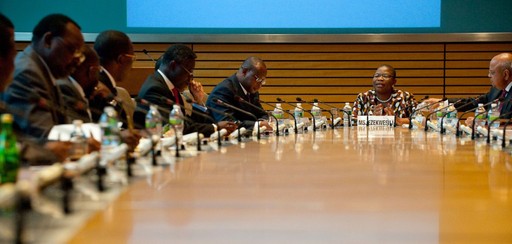
A Group of ACP Country Delegates – Courtesy of the World Bank
Just last week, in what was termed ‘the first official high-level structured dialogue between the Caribbean Community leaders and Obama’s administration,’ U.S. Vice President Joseph Biden signed a trade and investment agreement with 16 island and low-lying coastal states.
Starting May 28, 2013, more than 15 million people and their countries could take advantage of an 85 percent tariff elimination on goods and services coming from their region. This negotiated agreement also established a special council to work on removing barriers to trade and investment between the U.S. and the Caribbean Community (CARICOM) states – addressing issues like renewable energy and energy security.
On the other side of the black spectrum, sub-Saharan Africa beneficiaries of the Africa Growth and Opportunities Act (AGOA) met May 30 and 31 at the World Bank in Washington, DC to review their non-reciprocal program and ensure that more than a billion Africans could take more advantage of access to the U.S. market.
Unfortunately, although there was some positive noise coming from respective quarters, the truth is that unless Africa, collectively, comes up with a ‘demand’ for more U.S. investment to go alongside an allowance for agricultural products like groundnuts, sugar or even tobacco leaf, AGOA may continue to be largely ignored on the continent.
The Habari Network is as pleased as Punch with the progress the Caribbean has made vis-a-vis its American trade and investment relationship. One can, actually, see how strategically important the Caribbean is to the U.S. Just like Cuba almost brought the world to its knees during the Cuba Missile Crisis of the 1960s, the Chinese are ‘invading’ off-shore locations near the North America.
Of course, most of these are China’s entrepreneurial ventures into lucrative opportunities presented by American tourists and investors. However, like anyone knows, these economic interests present a clear and present danger to U.S. national security; thus, it was understandable that the U.S. needed to do something beyond the Caribbean Basin Initiative (CBI).
Initially launched in 1983 and in effect till September 2020, the CBI, just like AGOA does, provides 17 countries with duty-free access to the U.S. market for a few goods.
However, just like AGOA, CBI, which was substantially expanded in 2000 through the U.S.-Caribbean Basin Trade Partnership Act (CBTPA), was only going to be more effective if it was not looked at as a gift from the American people.
With this recent agreement between the U.S. and CARICOM, there’s a chance that the negotiated responsibilities for both parties will be more effective for the lives of the people.
That is why we, wholeheartedly, endorse the spirit of a proposal named the Trans-Atlantic South Partnership. Published by the prestigious Woodrow Wilson Center, the premise of this paper is that the U.S. relationship with Africa must be elevated onto the same plane as that one with the Far East (The TransPacific Partnership – TPP) and the US – European Union Trans-Atlantic Trade and Investment Partnership (T-TIP).
From this perspective, the U.S. ought to, essentially, recognize that 8 of the world’s fastest growing economies are in sub-Saharan Africa and that the Chinese, the European Union and third countries present a severe challenge to U.S. hegemony if they continue to outpace U.S. investment in the region.
Secondly, its important for the U.S. Congress to not just renew AGOA before its 2015 expiry: AGOA must be enhanced to effectively promote regional integration, to look into commercial agricultural production in Africa – and especially to prevent the European Union from foisting their ‘fatally flawed’ economic partnership agreements (EPAs) on individual African countries.
Regional economic communities like CARICOM and the African Union present the best hope for the respective regions to progress to the next level. It never helps any one of the African or Caribbean nations to negotiate on their own. Besides, many of the American firms – just like other multinational corporations in play – would much rather, do business with 19 countries in one agreement.
Editorial Board | The Habari Network
editor@thehabarinetwork.com