News
Augmenting Africa’s Economic Progress
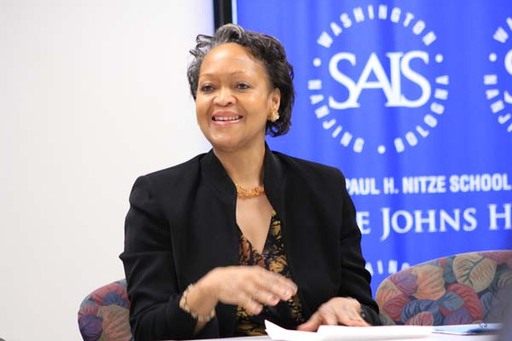
Florie Liser, Assistant U.S. Trade Representative for Africa
10:00 a.m. – March 11, 2013
By Dennis Matanda
With the flair of a seasoned storyteller, Stephen Lande holds sway over what might have, otherwise, been a mind-numbing topic. Teaching a rigorous course on how Africa navigates global trade dynamics, the adjunct professor brings to life the aphorism that those who were actually there tell it best: Lande was, after all, the first of two assistant U.S. Trade Representatives, responsible for all bilateral trade negotiations. But practical tales and sagely anecdotes notwithstanding, what students at Johns Hopkins’ School of Advanced International Studies may relish more is the occasional special guest that graces their Washington, D.C campus.
And a few Mondays ago, the class, your humble correspondent in attendance, were especially pleased with not just one but two special guests! First, came an energetic presentation on the World Trade Organization (WTO) from Alan Kyerematen. A former Ghanaian trade minister and ambassador to the United States, Kyerematen could well become the 6th Director General of the World Trade Organization this May 31st 2013 – the first African that would hold this position.
Following him was Florie Liser, Assistant U.S. Trade Representative for Africa. An illustrious alumnus of this very school, Liser probably engages in more African trade negotiations than anyone else in the U.S. government, and thus, her painting of the global trade landscape within which African countries participate was especially instructive in serving up both optimistic trends and significant challenges. She highlighted that two-way U.S.–sub-Saharan African trade has grown significantly, reaching US$71.2 billion in 2012, with African exports of US$49.7 billion – more than double what it was in 2000 when the African Growth and Opportunities Act (AGOA) was first enacted. Our own research revealed that all 50 individual American states had increased exports to Africa in 2012.
Equally important, Liser noted that Africa is also experiencing a steady increase in exports of a growing array of non-oil, manufactured products to the United States – from autos to apparel, footwear, and value added agricultural products – which totaled US$5 billion in 2012, five times more than they exported prior to AGOA. In contrast to exports of oil and energy-related commodities where there are a limited number of AGOA beneficiaries, the majority of the 38 AGOA-eligible countries are now exporting non-oil products to the United States.
Yet, collectively, Africa is still a relatively small player in America’s US$15 trillion GDP market – accounting for less than 2 percent of total U.S. imports in 2012. This type of analysis of the patterns and composition of Africa’s trade with its other major trading partners is critical in understanding Africa’s current and potential benefits from the global trading system. China, for example, is now Africa’s largest single country trading partner – surpassing the United States in 2009, but Africa still mostly supplies primary inputs for the many finished products that China ships back to the continent and elsewhere.
A recent McKinsey Global Institute report suggests that this primary product weakness extends into the fact that Africa’s natural resource sectors employ less than 1 percent of Africa’s workforce. But Liser’s address noted that with the 49 mostly landlocked sub-Saharan African countries, great progress could be made through regional economic integration, as is currently happening in regional economic communities such as the East African Community (EAC), Economic Community of West African States (ECOWAS) and Common Market of East and Southern Africa (COMESA).
Increased intra-African trade could emanate from fewer cross border barriers to trade and investment. Jointly taken, these activities would allow Africa to harness its potential in the global economic system. According to Liser, investors will go where they are confident about the ease of doing business; about policies that support trade, investment and joint ventures with African businesses. She also noted that while Africans benefit from one-way trade preference programs such as AGOA, they could realize even greater benefits by improving competitiveness, opening up to more liberalized multilateral trade, as well as potentially seeking two-way trade agreements with its major trading partners.
For example, South Africa – a major beneficiary of AGOA non-oil trade amongst the Africans – is already making economic strides from a two-way trade agreement with the European Union, but is yet to pursue a potentially lucrative trade partnership with the world’s largest singular market in the United States. Likewise, the United States stands to benefit a great deal by doing even more business with Africa – the world’s fastest growing region. In taking advantage of the natural synergies that exist between the two regions, this could contribute to a more dynamic, 21st century U.S.-Africa trade relationship that builds on and potentially goes beyond AGOA.
There are prospects in Africa’s market of 1 billion people, Liser said: In the growing middle class, and yes – in the economies of scale realized by eliminating cross-border barriers across Africa. With barriers dispensed with, and national infrastructure developed or expanded to facilitate regional and global trade, Africa stands a greater chance of establishing its place in global supply chains and distribution networks.
A book, Why Nations Fail by Acemoglu & Robinson presents the nebulous notion that Africa’s economic doldrums are this severe not because people do not know which policies foster growth but because political machination prevents growth if deemed detrimental to the few oligarchs – industry incumbents – benefiting from the status-quo. But this view is not supported when one looks at a number of African nations, including the blossoming economies of the Ivory Coast, Niger or Ghana highlighted in a recent expose in The Economist.
Already speaking volumes, African countries are swimming against the tide – overcoming the administrative and capacity challenges of the past. McKinsey tells us that Africa is on track to create between 54 million to 72 million more stable wage-paying jobs by 2020 as a result of current investment in manufacturing, agriculture, retail and hospitality, and as agreed by most experts, infrastructure, financing, business environment and workforce will be key to Africa’s prosperity. With wage-paying jobs growing to more than 36 percent of the total workforce in less than a decade, this 54–country ‘diverse mosaic’ of pre-transition, transition, diversified and oil exporting on the African continent could create stable jobs at a faster rate than those created by Thailand, South Korea and Brazil when these three were at Africa’s stage of development.
That’s why Liser is very optimistic. Notwithstanding some of the cautions and widely recognized challenges, the U.S. government will continue to work with its African partners, the U.S. and African private sectors, and other stakeholders to help realize Africa’s great and full potential to grow its economies through trade and investment.
dmatanda@gmail.com
With additional comments and suggestions from Emmanuel Musaazi, Ryan Elcock, Stephen Lande, Florie Liser and Oscar Sekyewa. For comments, please write to The Editor: editor@thehabarinetwork.com .
The author is an American Politics & Government post graduate scholar from Uganda and concurrently works in both New York and Washington, DC while serving as editor and on the editorial board at the The Habari Network. He lives with his wife Rachel in Princeton, NJ and is finishing his second book, Master of the Sagging Cheeks, a work of political fiction.