Opinion
Analysis of the U.S. National Security Outlook under Obama
By Emmanuel Musaazi
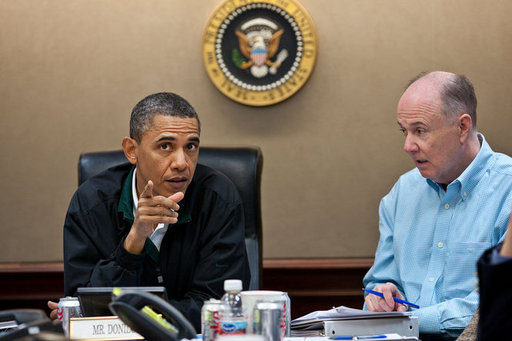
U.S. President Barack Obama making a point during one in a series of meetings in the Situation Room of the White House discussing the mission against Osama bin Laden, May 1, 2011. National Security Advisor Tom Donilon is pictured at right. PHOTO/Pete Souza
U.S. President Barack Obama has presided over one of the shrewdest and most pro-America national security policy in recent times. Unlike previous American presidents who sometimes triumphed or failed on the high altar of treaties or ally rapprochement, Obama more than any president in recent history has led almost solely on the motivation of the American agenda.
The more hawkish traditional types see Obama as a threat to an established order which has endured since the end of the Second World War.
Obama’s argument may be that he came to office in difficult times when the very essence and existence of the United States of America was on the line hence the “out of the box” unorthodox approach to solving foreign policy and national security concerns among others.
Question: Is the Obama doctrine on national security just a more radical leftist outlook or a forward looking pragmatic course of action best suited for the times?
Obama seems to have discarded the hitherto bipartisan “one size fit all” American national security policy prescription for a more pragmatic “case by case” approach which he alluded to as candidate Obama more than four years ago in 2007-2008.
In response to Senator McCain in the 2008 presidential debates, then Senator Obama said “if the United States has al-Qaeda, bin Laden, top-level lieutenants in our sights and Pakistan is unable or unwilling to act, then we would take them out.” By showing a willingness to put the American interest paramount and sacrosanct to the interests of allies, those in the Obama camp viewed the response as a demonstration of Obama’s patriotism and suitability for the Commander-in-chief role.
On the other hand, given that Pakistan was/is an ally on “the war on terror”, the suggestion was roundly repudiated and ridiculed by Democrats and Republicans steeped in the ways of old, with then Senator Joe Biden (ironically now Obama’s Vice President and member of his national security team) describing such a posture as naive.
Obama’s position was viewed as radical and a threat to the foundation of American foreign policy tenet since the Second World War, which has meant in some cases putting alliance, ally interests ahead of the American interest. This mind set was displayed in senator McCain’s follow up to Obama’s answer “If you are a country and you’re trying to gain the support of another country, then you want to do everything you can that they would act in a cooperative fashion.”
The Obama/McCain exchange on Pakistan may have served as a delineator between the old and contemporary outlook on national security.
It may be argued that now more than ever, America needs the allied structure to execute her national security obligations given the unconventional/asymmetric nature of the war on terrorism and her vulnerability economically emerging from a recession. However, a counter argument could be made that over-commitment to the ally structure as a vehicle for achieving foreign policy and national security goals may be the cause of most of the intractable national security problems that America is embroiled in.
The idea of having to “scratch” an ally’s “back” in order to get the ally/allies to “scratch” back has sometimes meant America having to support dictatorships and policies that are against her core values of freedom, democracy and the rule of law. This in turn has led to a growing negative perception of America internationally. As a result the enemies of America’s budding ally pool have become America’s enemies as well.
For example, American leadership in NATO was instrumental in effectively stopping the spread of communism in Europe mainly because NATO allies had shared values. The NATO template has been ineffective in other global theaters mainly because America has allied herself with nations with which it does not share values.
The flaws in this policy can be seen in the intricate relationship America has with her three big strategic allies; Israel, Egypt and Pakistan. Rightly or wrongly, the “war on terrorism” which is presently America’s most pressing foreign and national security headache has arisen through association with either or all of the above nations.
The goal of the Obama doctrine appears to be to reverse this downward spiral of American foreign policy and national security strategy by pursuing a more pro-America foreign policy and national security agenda based on American values but potentially at the expense of ally interests. This is evident from the authorization of the Osama bin Laden hit in Pakistan without Pakistani acquiescence to President Obama’s public spat with Israeli Prime Minister Benjamin Netanyahu over the Iran nuclear weapons standoff and apparent American support of the Arab spring episode which lead to the ouster of President Hosni Mubarak of Egypt an erstwhile staunch and strategic ally.
The jury is not yet out as to the long-term impact of an Obama national security strategy on America and the world. The skeptics are worried by the potential fallout and fear that in the case of a desert storm like crisis, America may not have many friends heeding her clarion call. Those in support say that the new approach is inevitable alluding to the fact that some of the most costly national security crises both in blood and treasure have occurred as result of America attempting to honor ally obligations. Case in point is 9/11 and Osama bin Laden. It can be argued that had then President Clinton gone ahead and acted on intelligence and taken out bin Laden without first giving ally Pakistan a heads-up about the intent, 9/11 and its spin off crisis, in Iraq and Afghanistan may have been mitigated.
Skeptics feel that the present policy risks portraying America as less hawkish, weak, unwilling and unable to lead in an ally structured foreign policy and national security strategy thus emboldening her enemies. However in fairness to President Obama his approach has been more hawkish than his given credit. He has been able to forge a balanced foreign policy and national security strategy that has worked in and out of the ally structure. This was shown in the eventual role played by America in the Arab Spring saga providing reconnaissance and some airpower in an allied effort to oust Colonel Gaddafi in Libya. In addition, Obama assembled a hawkish national security team including former Republican appointees: Gen. Jim L. Jones, Gen. David Petraeus and former Defence Secretary Robert Gates.
President Obama has also gotten support from the likes of former George W. Bush’s national security adviser Gen. Brent Scowcroft who is as hawkish as they get on nuclear weapons and Iran.
Since 9/11 the number one national security priority of America has been to disrupt, dismantle and defeat terrorism. The Obama doctrine on national security is shaped by this goal in seeking to achieve national security objectives. However this aspiration has to be achieved on a slimmer budget because of the prevailing poor economic realities of America and curtailed casualties to appease the war wary American public and international community. This has necessitated the apparent rebranding of American military power from a predominantly shock and awe outfit with a large footprint to a smarter intelligence driven outfit with a lighter footprint.
The new military strategy has been used effectively in eliminating major terrorist targets such as Osama bin Laden in Pakistan using Special Forces and Anwar al-Awlaki in Yemen using drones. The drone has been the de-facto weapon of choice used to eliminate scores of terror targets and a revelation in the Obama era.
The Benghazi episode in Libya, in September 2012, however, is a stark reminder of the need for the American army to maintain its might and projection capacity. This balancing act is a must and Obama the pragmatic politician that he is, understands it.
Emmanuel Musaazi is a college professor based in Toronto, Canada.